
When any holiday rolls around, we want our pets involved in the fun, since they’re beloved members of the family. A few holidays call for keeping an extra eye on our fur friends, though, and Halloween is one of them. Between the elevated stress levels and the hazards that come with the night, it’s worth being on alert. Below are some tips to help keep your pets safe and calm on this spectacularly spooky night.
Take Steps to Reduce Their Stress
Many pets are territorial and alert to activity at the door, so a knock or a doorbell ringing every few minutes is likely to send their stress levels up.
Consider the following to keep your pet calm this Halloween:
- Leave the treats for trick-or-treaters in a bowl outside to cut down on knocking and doorbell ringing, or sit on the porch or driveway to greet your Halloween guests.
- Set your pet up in a quiet room well away from the front door during trick-or-treating hours, with some treat-filled toys or a stuffed Kong to occupy them.
- If your pet is already comfortable in a crate, that works well too, as long as the crate is somewhere they already like being—Halloween isn’t the night to introduce one for the first time, and a crate should never feel like a punishment.
- Leave a radio or television on to help mask the noise outside, and draw the curtains so passing costumes and flashlights don’t set your pet off.
- Take your dog for a good walk earlier in the day, before it gets dark and busy. A tired dog copes far better with an eventful evening.
- If your pet is genuinely frightened by this kind of thing, talk to us in advance—there are options that can help, and they work much better when planned ahead rather than on the night.
Make sure your pet is wearing ID tags, and take a minute to check that your microchip registration details are current. A frightened pet slipping out through a door that keeps opening is the single most common Halloween emergency, and up-to-date identification is what gets them home.
Be Careful with Costumes
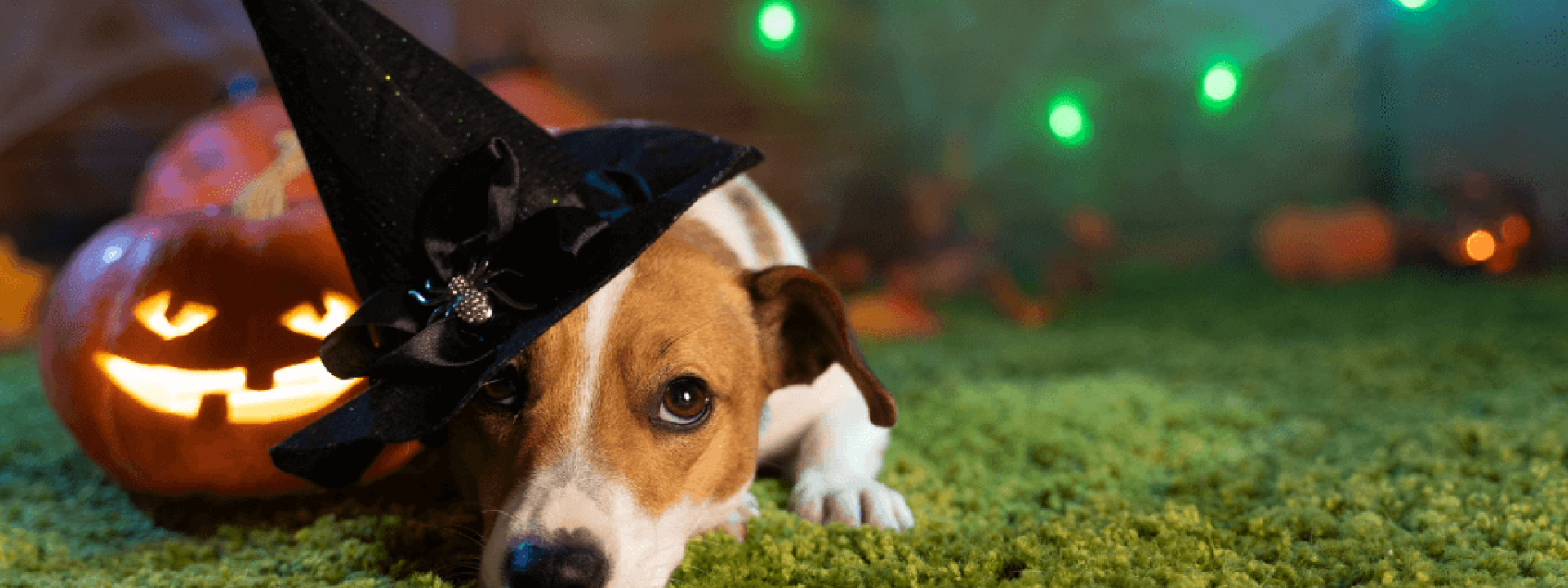
It’s tempting to include your pet in the family costume theme. There’s nothing wrong with that, but inspect any pet costume closely first—look for clasps, gems, bows, elastic, or any small part they could pull off and swallow. Try to choose something that suits their temperament, too. If your dog has never tolerated hats or headbands, skip the costume that needs one.
A costume shouldn’t restrict your pet’s ability to walk, see, hear, breathe, bark, or use the bathroom, and nothing should be tight around the neck. Never leave a costumed pet unsupervised, since a costume that shifts can become a tangle or a choking hazard.
Take the costume off if your pet looks uncomfortable. In dogs, watch for ears held back or flat, a tucked tail, lip licking, yawning, whale eye—where you can see the whites of their eyes as they look sideways—freezing, or moving stiffly. Cats often simply stop moving altogether, which is worth recognizing as distress rather than acceptance. A festive bandana is a perfectly good alternative for a pet who isn’t enjoying the full outfit.
Keep Candy Stored Away
Halloween candy can cause serious problems for pets. Chocolate is the big one—dark and baking chocolate are the most dangerous, and it doesn’t take much in a small dog. Xylitol, an artificial sweetener found in many sugar-free candies and gums, is even more dangerous, causing a sudden drop in blood sugar and liver damage in dogs at small doses. Raisins are toxic too, and a lot of candy contains macadamia nuts. Wrappers and lollipop sticks are a hazard in their own right and can cause an obstruction if swallowed.
To keep your pets away from Halloween candy:
- Store it in a high, closed cabinet rather than a bowl on the counter.
- Make sure your kids understand the dangers, so they don’t leave candy lying around or decide to share it with the dog.
- On Halloween night, keep the bowl for trick-or-treaters outside the front door.
- Once the kids are back, get the candy sorted and stored straight away rather than leaving it on the floor—most dogs can reach a low table or a couch, and a pillowcase of candy left unattended is an accident waiting to happen.
- Empty wrappers count too, so keep the trash secured.
If your pet does get into the candy, don’t wait for signs to appear. Call us right away, or contact the ASPCA Animal Poison Control Center on 888-426-4435—note that a consultation fee may apply. If you can, have the wrapper to hand so we know what and roughly how much was eaten, and your pet’s weight. Don’t try to make your pet vomit unless we’ve told you to.
Signs of chocolate ingestion include vomiting, diarrhea, restlessness, rapid breathing, an increased heart rate, tremors, and seizures. With xylitol, weakness, wobbliness, and collapse can come on within half an hour. In both cases, treatment started early is far more effective than treatment started once your pet is unwell.
Avoid Taking Them Trick-or-Treating
It might seem natural to grab the leash and bring your dog along with the kids, but it’s usually a bad idea. In the dark you won’t see what your dog is picking up off the ground, which can lead to an upset stomach or worse. You’ll pass a great many people in costumes, which is stressful for most dogs and can produce a lot of barking. Some of those people will be small children, and a dog appearing unexpectedly out of the dusk can frighten a child badly—or lead to a bite that nobody wanted. Dusk and evening are also when raccoons, coyotes, and other wildlife are on the move, and that’s an encounter best avoided.
If you do take your dog, keep them on a short leash rather than a retractable one, put a reflective collar or light on them, and be ready to turn back if they’re not enjoying it.
A Few Other Halloween Hazards
- Candles and jack-o’-lanterns. A wagging tail or a curious cat can knock one over easily. Flameless LED candles remove the risk entirely.
- Decorations. Fake cobwebs, streamers, and string lights are all tempting to chew and can cause an obstruction—and cords carry a risk of electric shock.
- Glow sticks. The liquid inside isn’t usually seriously toxic but it tastes foul and causes drooling and vomiting.
- Cats and Halloween. Keep cats indoors for a few days either side of the holiday, and black cats especially. There’s more traffic, more noise, and more people about than usual.
Halloween is a favorite for kids and parents alike, and pets can be part of it with a few precautions. Dress them up for photos earlier in the day if they enjoy it, then settle them somewhere quiet before the trick-or-treaters start arriving. The AVMA has some further tips as well. If you'd like more advice about keeping pets safe over the holidays, or your companion is overdue for a wellness visit, please give us a call.