
A raised temperature in your dog can happen for more than one reason. It might be a fever, which usually points to infection, or it might be environmental—heat and humidity pushing their body temperature up faster than they can shed it.
A dog's normal temperature runs between about 99 and 102.5°F. Readings in the 103 to 105 range suggest heat exhaustion. Above 105°F, your dog is at risk of heatstroke, which can be fatal.
Which Dogs Are Most at Risk
Some dogs cope with heat considerably less well than others.
- Flat-faced breeds—bulldogs, French bulldogs, pugs, boxers, Boston terriers. Their shortened airways make panting far less effective, and they can overheat on a day another dog would manage comfortably.
- Overweight dogs, who carry extra insulation and work harder to move.
- Thick-coated and dark-coated breeds, and northern breeds bred for cold climates.
- Very young and elderly dogs.
- Dogs with heart or respiratory conditions, or laryngeal paralysis.
- Herding and hunting breeds, who will keep going well past the point of sense because they're enjoying themselves—these dogs need watching rather than trusting.
- Any dog on the first hot days of the season, before they've acclimatized.
Worth remembering that humidity matters as much as temperature. Panting works by evaporation, and when the air is already saturated, evaporation slows—so a humid 80°F day can be more dangerous than a dry 90°F one.
Signs of Heatstroke
Dogs don't sweat the way we do. They have sweat glands only in their paw pads, so panting is their main route for shedding heat—and once panting can't keep up, body temperature climbs quickly.
Early signs:
- Heavy or frantic panting
- Excessive drooling, with saliva becoming thick and ropey
- Bright red gums and tongue
- Restlessness, or seeking out shade and cool surfaces
- A racing heart
Signs of a genuine emergency:
- Unsteadiness, stumbling, or weakness
- Vomiting or diarrhea, sometimes bloody
- Gums that look pale, purple, gray, or blue
- Gasping, or laboring to breathe
- Confusion, collapse, seizures, or unresponsiveness
What to Do
Act immediately—minutes matter.
- Get your dog out of the heat, into shade or air conditioning.
- Start cooling with cool water—not cold, and never ice water. Pour or hose it over the whole body, concentrating on the neck, armpits, groin, and belly, where large blood vessels run close to the surface. A cool bath works well if you have one to hand. Ice water constricts surface vessels and can actually slow cooling, as well as causing shivering that generates more heat.
- Get air moving over them with a fan, or by driving with the windows down or the air conditioning on. Evaporation is what does most of the work.
- Don't drape a wet towel and leave it there—it traps heat rather than releasing it. Keep the water moving and refreshing instead.
- Offer small amounts of cool water if your dog can drink, but never force water into the mouth of a dog who is disoriented or struggling to swallow.
- Get to a veterinarian. Call us on the way, or head straight for the nearest emergency hospital.
Please have your dog seen even if they seem to recover. This is the part owners most often skip, and it's the most important thing on this page. Heatstroke damages organs, and the consequences—kidney failure, clotting abnormalities, gastrointestinal bleeding, and brain swelling—can develop over the following 24 to 48 hours in a dog who looked perfectly fine once they'd cooled down.
Treatment of Heatstroke
The mainstays are intravenous fluids and electrolytes alongside continued controlled cooling. We'll run blood work—a complete blood count and chemistry panel along with clotting times—to assess how much damage has been done.
Depending on what we find, treatment may also involve a plasma transfusion if clotting is affected, medication to protect the gastrointestinal tract, anti-seizure medication, oxygen, and monitoring over the following days. Dogs who've had heatstroke usually need hospitalizing rather than treating and sending home, precisely because of how the complications unfold.
Avoiding Trouble in the First Place
- Never leave your dog in a parked car. Not for a minute, not with the windows cracked, not in the shade. A car's interior climbs to lethal temperatures within minutes on a day that feels merely warm outside. Leave them at home, or take them in with you.
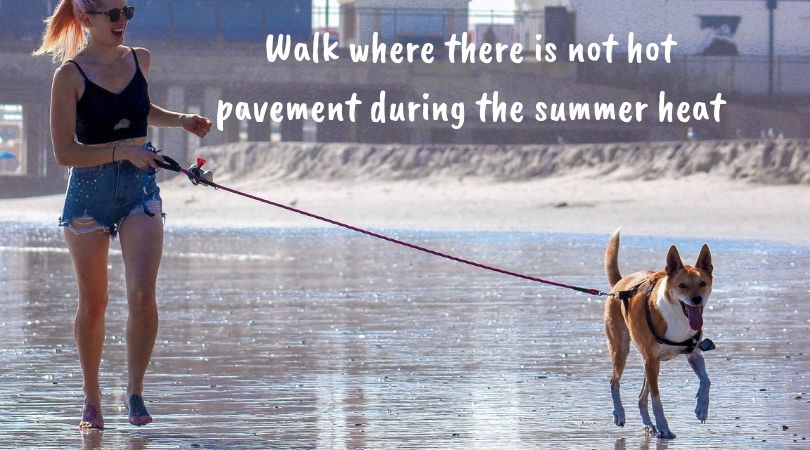
- Walk early or late. Early morning and evening are cooler, and the pavement has had time to lose its heat.
- Test the pavement first. Press the back of your hand to it for a few seconds—if you can't hold it there comfortably, it's too hot for paws. Asphalt and concrete cause real burns, and they radiate heat upward at the height your dog actually lives.
- Provide shade and water whenever your dog is outdoors, and check the shade will still be shade in a few hours as the sun moves.
- Cut back on exercise when it's hot, and skip the walk altogether on the worst days. A day without one won't hurt your dog.
- Don't rely on a fan alone for a dog left indoors. Fans help people because we sweat; they do considerably less for a dog.
- Be careful around water too—a dog swimming in the sun can still overheat, and salt or pool water shouldn't be their drinking supply.
If you have questions about keeping your dog safe as the temperature climbs—or if your dog is one of the higher-risk types above and you'd like to talk through what's reasonable for them—please get in touch.